Pages

Tuesday, 6 November 2012

Looking at Man City's 'zonal marking'

Over the past few weeks, zonal marking has again taken a bit of battering. Only on Saturday, Jamie Redknapp was readily criticising use of the system during Man United's win over Arsenal, even though zonal marking had nothing to do with the goal he was talking about. Surprisingly he wasn't so quick to point out a set piece chance for Arsenal in the first half where a simple block from Mertesacker on a man-marker left Giroud free in space for a great chance.

Because of this, you may forgive me for being surprised it took over half an hour for Andy Townsend to have a go at zonal marking (or 'zoning' as he called it) in Man City's draw with Ajax on Tuesday night. This time it was the old 'players don't know whose job is whose', even though if you bothered to study the system, it's generally pretty clear.

There are worse cliches trotted out admittedly. 'A zone has never scored a goal' is a big favourite for many clueless pundits, completely ignoring the fact that most teams pretty much use zone defending in open play. They also ignore the fact that from free-kicks in certain positions, like out wide, teams pretty much always use one line of zonal.

And that brings about another thing. Just like in open play where teams use a mixture of man marking and zonal marking, teams who use so-called zonal marking from set pieces are often instead using a mixture of both. This varies admittedly. Some have players on the posts (another example of zonal marking which is never pointed out), some have a different amount of players defending in different positions. The most important thing however is how the players perform it.

Let's concentrate on the second goal Man City conceded against Ajax:

 
As you can see, Man City are defending with one line of man-to-man and one line of zonal - three players in front marking one player each and then four players behind marking zonally.


As the corner comes in, Toure lets De Jong run off him. Arguably he should try and slow De Jong's run down by blocking him to stop the momentum. However the biggest mistake here comes from Gareth Barry at the near post who simply fails to attack the ball.


Far from blaming the marking system, the main reason it failed was through players not doing their jobs.

Why didn't City have men on the posts then? Well this is another thing that often gets pointed out when goals are conceded from corners. There's not necessarily a right thing to do in that situation. Some teams play with men on the posts, some teams choose not to. However, there are valid reasons for both.

Admittedly you may clear three or four a season off the line if you have men on both posts. But instead of concentrating on that, why not have more players focussing on winning the first ball from the corner? Having no players on the post means that you can leave one or two players up the pitch, you can maybe have one or two on the edge of the box and you'll still be able to defend properly.

Another reason for not having men on the posts is the second ball. Many teams are not good enough at pushing out from corners. They can get trapped in their own area and inevitably make mistakes leading to a goal or penalty. If you have one or two players marking posts then it makes it difficult to play offside when the second ball comes in. Take a look at this example from Bayern Munich vs Borussia Dortmund last year.

 
As Dortmund take a short corner, you can see Arjen Robben standing on the far post.


Bayern clear the first ball that comes into the box. Meanwhile, Robben is standing just in front of the post.
 
 
However as Dortmund win the second ball, Robben doesn't get out quick enough, playing Lewandowski onside. In this situation, it was Lewandowski who got the final touch for the goal which ended up winning the match for Borussia Dortmund.
 
 
Bear in mind this is not a piece intended to say that one way is better than the other. There are arguments for and against each system. The objective truth though is that the performance of each system is down to the players and if you're so keen to blame someone for conceding set piece goals, blame them not the system.


Wednesday, 3 October 2012

Man City 1-1 Dortmund - Away side dominate but don't win

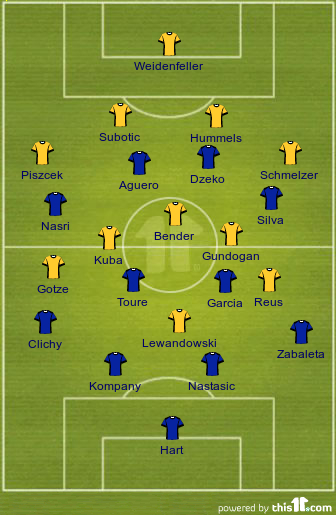
Man City started with both Aguero and Dzeko up front, combined with Silva and Nasri in the wide positions. Nastasic started at the back.

Dortmund set out closer to a 4-5-1 shape with Gotze on the right, Kuba inside of him with Reus on the left.


First half

Jurgen Klopp said yesterday that his side had a plan to stop City playing and they stuck to their word. Dortmund defended as a 4-5-1, looking to stop City playing through the middle to Silva and Nasri between the lines. The away side's plan defensively was to start their press around the half way line especially the City holding players of Toure and Garcia when they had their back to the play. With Mancini's side using very slow transitions, the Germans were able to get behind the ball quickly into their shape and stop City playing penetrating passes down the middle.

This meant a number of things. The main thing was that it was almost impossible for City to play a forward pass between the lines. Two of their biggest chances in the whole match, came from two of the only times they'd manage to turn between Dortmund's defence and midfield.

The second thing it meant was that Yaya Toure was unable to make runs from holding midfield; he was pressed when he received it close to the half way line and Dortmund were so compact that it was very difficult to find space in the middle. Even when City went wide, Dortmund pressured with three players stopping penetration.

Dortmund pressing with three players in the wide areas

City therefore only really looked a threat when they went long for Dzeko (who was caught offside four times) or on quick transitions, few and far between.

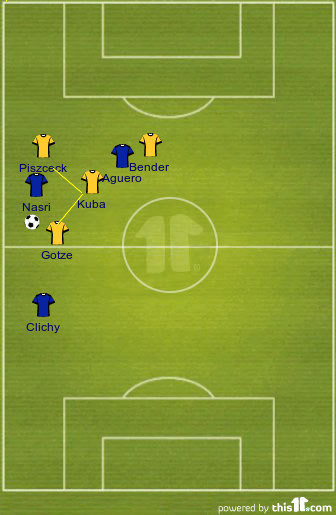
Dortmund's attack was also extremely impressive. Klopp's side use of pressing triggers (waiting for loose pass, horizontal pass, one player presses then the whole whole team presses), led to some very dangerous counter attacks and it was only because of Joe Hart that it was 0-0 at half time. Dortmund had especially targeted the right hand side when attacking with Gotze, Piszcek and Kuba all drifting towards that area and the combination play on the edge of the box was superb. Add to that the factor that both full backs got high, allowing Gotze and Reus to move between the lines with Gundogan and Kuba meant they could support Lewandowski well from midfield and then press high when they lost possession.

Second half

Things didn't particularly change at the start of the second half; City were still moving the ball horizontally side to side in deep positions and generally unable to penetrate vertically, though they were looking for Dzeko more in the air.

The first main change from City came in the 57th minute, bringining on Kolarov for Nasri. It made some sense - they weren't getting any joy from their usual precise build up and having a more direct route was worth the risk. However the change to a 3-4-1-2 didn't really work. It allowed the full backs to pressure higher for Dortmund against the wing backs and defensively City looked very suspect with Dortmund able to continually test Joe Hart. In the 61st minute Reus followed the pressing trigger of Gundogan winning the ball high up the pitch and beating Joe Hart.

Mancini soon changed it back to a slightly lopsided 4-2-2-2 with Kolarov playing left wing and Zabaleta moving back to make a back four. However their transitions were still too slow, Dortmund were covering the space yet also playing with a high line to stop themselves from getting pushed too deep and ready to regain and counter attack from the middle of the field. Even when City went long, Dortmund were winning the second balls and playing out from the back well. City's only major threat was Aguero's mobility behind the Dortmund centre backs. It took a very generous penalty decision for City to break through.

Conclusion

Dortmund got their gameplan pretty much spot on. They kept their shape, made it impossible for City to find penetrating passes down the middle and created chance after chance in attack. They probably should have made the most of their chances but they dominated City right from the start. Mancini's side will have to improve their balance and intensity if they're to get through this group stage.

Monday, 17 September 2012

Everton 2-2 Newcastle: Pardew's changes get draw

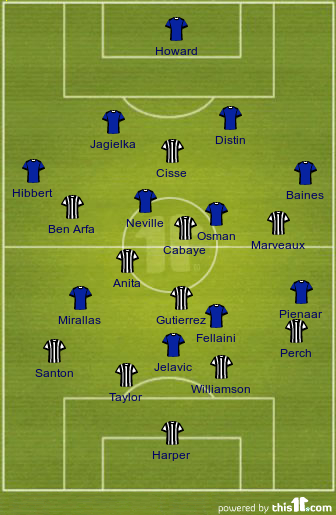
Everton as the home side started with a 4-2-3-1 shape. New signing Mirallas played on the right while Fellaini played behind Jelavic up front.

Newcastle started with Demba Ba only on the bench, with Papiss Cisse up front, Gutierrez, Cabaye and Anita making up the midfield, and Marveaux and Ben Arfa in the wide areas.


Everton dominate first half

The first half was completely dominated by Everton. They played at a higher tempo, were more aggressive, won the second balls and forced Newcastle back.

The home side dominated the first half for a couple of reasons. Firstly their direct threat in the air was always an option; if Newcastle blocked the passing options for the Everton centre backs, Fellaini and Jelavic were both available for the long ball forward and Everton supported well and aggressively enough to win the second ball. From there they could push the Newcastle backline deeper and control possession with their switches of play, especially to the left hand side.

That left hand side was where Everton's biggest offensive threat came from - Newcastle weren't compact enough when the ball was switched to that area and they never got tight enough to pressure and stop the dangerous link ups that were occuring between Baines and Pienaar and the speed at which it happened. The first goal came from exactly this situation. As Gary Neville said in his analysis at half time, Newcastle didn't move across as a compact unit and Baines had plenty of space to make a penetrating run and score.

As for Newcastle's offensive threat, they carried virtually none. They weren't able to push Everton back and take advantage of their attacking threats because of the amount of possession Everton were having and also the way the home side were pressing. Long balls to Cisse in the air were fruitless; Distin was physically strong in the air to deal with him and the Everton midfield compacted the area around him well, making it difficult for Newcastle to win the second ball and build attacks. Ben Arfa, in particular had little chance to operate between the lines because of Newcastle being pushed back, though he did almost provide an assist with a pull back but the eventual shot was cleared off the line.

Half time changes

Alan Pardew had to make a some sort of change for the second half and he did, bringing on Demba Ba for Marveaux, switching to a 4-4-2 with Perch moved into midfield, Anita at right back and Gutierrez moved to right wing.

In theory this was the correct decision. Gutierrez was clearly more suited defensively against Baines than Marveaux had been in the first half and the physical threat of Ba and Cisse would provide much more problems to Everton's centre backs.

And so it proved. Newcastle were still having problems giving the ball away in their own half, allowing Everton to keep the pressure on but their attacking threat was more evident. For the equaliser, even though the home side gave the ball away poorly in midfield, when Cabaye won it there was a straight 2v2 on the counter attack and Ba got the equaliser.

That direct threat gave David Moyes' side far more of a problem. Like Jelavic and Fellaini had been for Everton in the first half, Ba and Cisse were always an option in the air to push Everton's backline back and that also allowed Ben Arfa more space between the lines to operate.

From there on, the game became more about who could push the other back. Both teams were direct and aggressive, looking to create with their physical threat in the middle. Anichebe wasn't as big a threat in the air as Jelavic had been and Moyes swapped him and Mirallas about 20 minutes into the second period.

Refereeing decisions aside, neither team had overall control of the second period as Everton had acheived in the first. Both teams looked to pressure aggressively, chase passes back to the goalkeeper and push the opponent back to take advantage of their physical threat. The changes made by both teams showed their intent on keeping things roughly the same; Naismith replaced Mirallas for Everton, Ameobi replaced Cisse for Newcastle.

Anichebe's superb turn and goal late on looked to have sealed the win for the home side, but Ameobi and Ba were still a big problem down the centre for Everton. The home side needed to try and move their backline as far out as possible and push Newcastle back into their own half but even just before the equaliser, they struggled to deal with a long ball down the centre to Ba and then moments later the movement of the two strikers, Ameobi coming short for the header with Ba looking behind for the flick on worked superbly and got the equaliser for Alan Pardew's side.